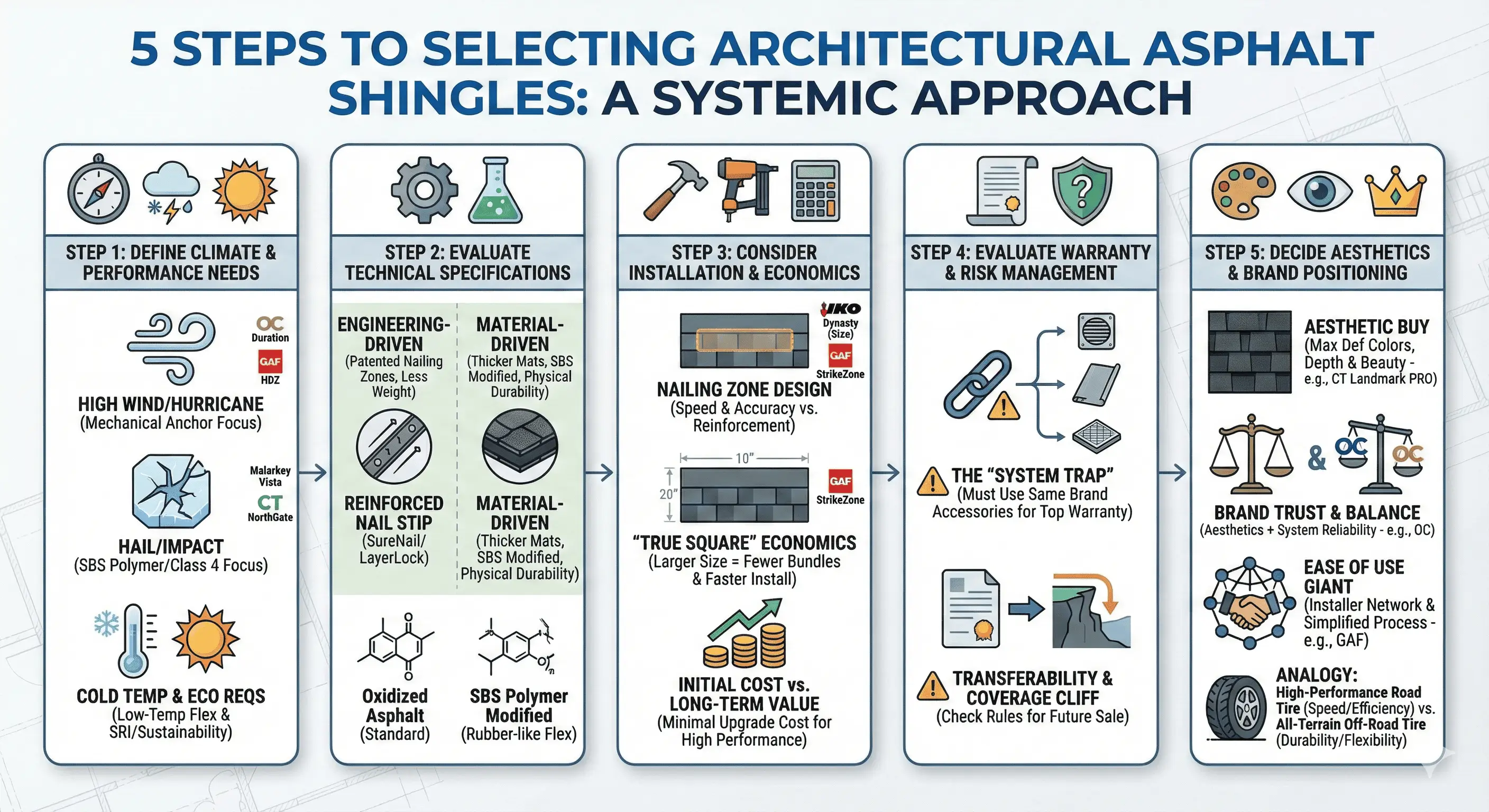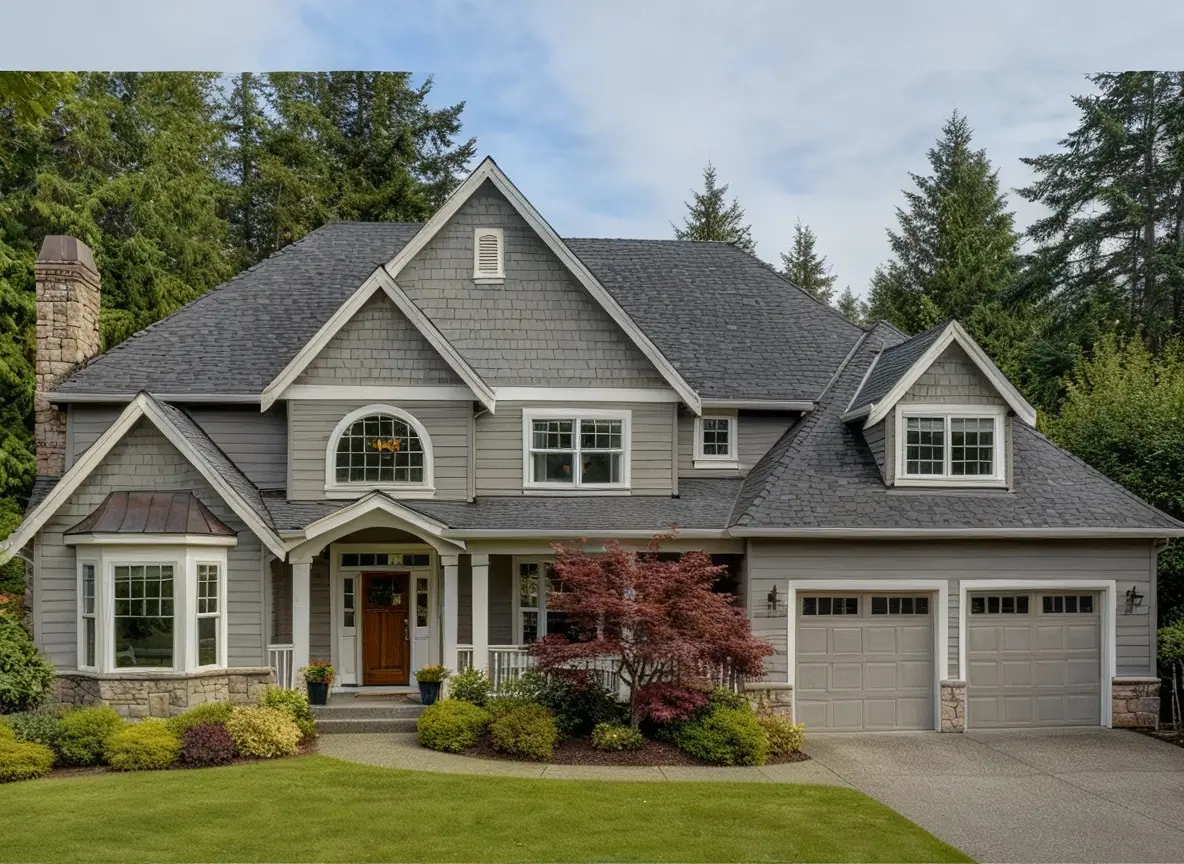
Pacific Northwest roof decisions are shaped by long wet periods, shaded debris, moss, wind-driven rain, trees, and large differences in roof geometry. The shingle brand is only one part of the system; deck condition, flashing, underlayment, ventilation, drainage, and workmanship often determine where leaks begin.
Scope: This guide helps homeowners inspect from safe locations, compare proposals, and ask better questions. It is not a roof design, code interpretation, cleaning recipe, or substitute for an on-site inspection.
1. When to request a professional inspection
From the ground, attic access, or interior, document:
- Missing, displaced, cracked, or visibly curled shingles
- Exposed areas or failed material around penetrations
- Granules accumulating unusually or exposed dark shingle substrate
- Damaged flashing, gutters, fascia, or roof-edge components
- Persistent moss, leaves, or branches holding moisture
- Ceiling stains, damp insulation, mold-like growth, or musty odor
- Sagging, uneven planes, soft decking, or repeated leaks
One symptom does not identify one cause. Curling can involve age, deck movement, ventilation, manufacturing, or installation. A stain may originate uphill from where it appears indoors. Ask the inspector to trace the water path and distinguish isolated repair from system-wide deterioration.
Treat active leaks, displaced shingles, sagging, and electrical exposure as urgent. Avoid climbing onto a wet, steep, moss-covered, or damaged roof.
2. Why Pacific Northwest exposure matters
Moisture alone does not establish a fixed “Seattle lifespan.” Roof slope, sun and shade, debris, ventilation, tree cover, salt exposure, workmanship, and maintenance create different microclimates on neighboring houses.
Use condition-based planning:
- Record installation date and product documents if known.
- Inspect after major storms and when interior symptoms appear.
- Track the location and progression of visible changes with photos.
- Budget for repair and eventual replacement independently of the headline warranty term.
A “lifetime” warranty is a legal coverage term, not a prediction that the roof will physically last for the owner’s lifetime.
3. Understand the complete roof system
| Component | Function | Quote question |
|---|---|---|
| Deck/sheathing | Structural surface supporting roof assembly | How is damaged decking identified and priced? |
| Underlayment | Secondary water-shedding layer | What exact product and where is it installed? |
| Ice/water membrane | Self-adhered protection at specified vulnerable areas | Which eaves, valleys, walls, and penetrations receive it? |
| Flashing | Directs water at walls, chimneys, valleys, and penetrations | What is replaced rather than reused? |
| Drip edge | Directs edge runoff and protects roof-edge materials | Is it included at eaves and rakes as required? |
| Ventilation | Manages heat and moisture under the roof deck | How was intake/exhaust balance determined? |
| Starter and ridge | Complete shingle system at edges and peaks | Are compatible listed products included? |
| Field shingles | Primary weather surface | Exact manufacturer, line, SKU, color, and class? |
The best shingle cannot compensate for failed flashing or an unsuitable deck.
4. Shingle categories and tested properties
Three-tab
Basic single-layer appearance and usually fewer premium product options. Verify local availability, wind classification, algae coverage, and future matching stock.
Architectural or laminated
Multi-layer appearance with a broad selection of product tiers. Exact wind, impact, algae, cool-roof, and warranty features vary by line.
Designer or luxury
More elaborate profiles intended to imitate slate or wood shake. They can add material, labor, structural-load, and repair-matching considerations; higher price does not eliminate the need to compare tested classifications.
Impact, wind, fire, and cool-roof information
- A UL 2218 impact class reports performance in a defined laboratory test; it does not guarantee freedom from hail damage.
- Wind coverage depends on exact product, deck, fasteners, pattern, accessories, installation, and warranty conditions.
- Fire classification applies to the tested roof-covering assembly and installation.
- Cool-roof eligibility must be checked against the applicable jurisdiction and approved-product information.
Ask for the current product data sheet, listing, installation instructions, and warranty—not a screenshot from an old comparison table.
5. How to read a shingle warranty
Separate four documents:
- Manufacturer material warranty
- Manufacturer enhanced-system warranty, if offered
- Contractor workmanship warranty
- Home insurance policy
For each, record:
- Covered defect or event
- Non-prorated and prorated periods
- Labor, tear-off, disposal, flashing, and consequential-damage coverage
- Registration and transfer deadlines
- Required contractor credential and system components
- Ventilation, deck, fastening, maintenance, and notification requirements
- Wind, algae, color variation, storm, impact, and normal-wear exclusions
Do not select a product by the largest number printed beside “years.” Compare what is covered and what the owner must do to remain eligible.
For a manufacturer-by-manufacturer worksheet, see Top 5 Best Asphalt Shingle Manufacturers in 2026.
6. Building a current King County budget
One roofing square equals 100 square feet of roof area. Roof area is not the building’s floor area; slope, overhangs, dormers, hips, valleys, and waste affect quantity.
Ask local bidders to itemize:
- Measured roof area and waste assumption
- Tear-off layers, disposal, and dump fees
- Deck replacement unit price and authorization process
- Underlayment and membrane products
- New versus reused flashing
- Ventilation changes
- Shingle, starter, ridge, and accessories
- Permits, setup, fall protection, and property protection
- Warranty tier and registration responsibility
Avoid undated regional price-per-square claims. Access, pitch, complexity, deck condition, material, labor capacity, and disposal can change the total more than shingle price alone.
7. Verify contractors in Washington
Use the Washington State Department of Labor & Industries Verify tool. Confirm the exact legal business and:
- Active contractor registration
- Bond and liability-insurance status
- Available violation or lawsuit information
- Registration name matching the contract
Also request current insurance evidence, recent local references, permit responsibility, subcontractor disclosure, and a written workmanship warranty.
Quote comparison checklist
| Item | Bid A | Bid B | Bid C |
|---|---|---|---|
| Legal contractor verified | |||
| Exact shingle and system | |||
| Deck replacement unit price | |||
| Underlayment/membrane scope | |||
| Flashing scope | |||
| Ventilation scope | |||
| Permit and cleanup | |||
| Workmanship warranty | |||
| Manufacturer warranty tier | |||
| Exclusions and total |
Do not accept same-day pressure, a large unexplained deposit, vague material descriptions, or oral promises that conflict with the contract.
8. Moss, algae, debris, and safe maintenance
Inspect from the ground and keep gutters and drainage paths managed using safe access methods. Roof cleaning can damage granules, flashing, coatings, landscaping, and waterways—and creates a serious fall hazard.
- Never pressure-wash asphalt shingles.
- Do not walk a wet or moss-covered roof.
- Avoid improvised bleach, vinegar, herbicide, or mixed-chemical recipes.
- Ask the shingle manufacturer which cleaning methods preserve warranty eligibility.
- Use a qualified roofer or roof-cleaning professional with fall protection and runoff controls.
- Evaluate zinc or copper accessories for roof compatibility, staining, runoff, and local environmental requirements before installation.
Replacing one shingle, adjusting flashing, or treating a valley is roof work, not a risk-free homeowner task. Document the issue from a safe location and use an insured professional.
9. Final decision framework
Choose a roof system by answering, in order:
- Is repair still appropriate, or is replacement justified by condition?
- What does local code require for this roof and exposure?
- What deck, flashing, drainage, and ventilation work is included?
- Which exact product classifications match the risks?
- Which contractor provides the clearest scope and strongest verifiable execution?
- What do the material and workmanship warranties actually cover?
- Can matching repair materials be obtained locally later?
The best-value Pacific Northwest roof is a complete, well-documented assembly installed correctly—not simply the heaviest shingle, longest headline warranty, or lowest quote.
Sources
- Washington State L&I: Verify a Contractor
- U.S. Department of Energy: Cool Roofs
- EPA Asphalt Roofing Manufacturing Information
Verify code, cleaning, product, and warranty requirements with the authority having jurisdiction and the current manufacturer documents for the exact roof system.