I. Executive Summary and Key Findings
A. Purpose and Scope
This report provides a comprehensive technical comparison between Hot Mix Asphalt (HMA) and Cold Patch Asphalt. The analysis examines material science, manufacturing processes, application methodologies, performance durability under various conditions, and a full life-cycle assessment of the economic and environmental impacts associated with each material.
B. Core Distinction
The primary finding of this analysis is that HMA and cold patch asphalt are not competing products; they are complementary systems designed for fundamentally different purposes. Hot Mix Asphalt is a structural paving material engineered for new construction, pavement overlays, and full-depth structural rehabilitation. Cold Patch Asphalt is a pavement repair material formulated specifically to fill localized defects such as potholes, utility cuts, and cracks.
C. The “Temporary vs. Permanent” Myth
A key finding is that labeling all cold patch materials as “temporary” is outdated and incorrect. This report shows two distinct types of cold patch:
-
Conventional Cold Mixes: These materials, which cure through the evaporation of solvents or water, are indeed temporary stopgaps designed to address immediate safety hazards.
-
High-Performance (HP) Cold Mixes: Modern formulations, often utilizing advanced polymers, cure via compaction. These materials demonstrate durability, adhesion, and water resistance that can rival HMA, offering a long-term, permanent repair solution.
D. The Economic Equation
The economic relationship between the two materials is inverted. On a per-ton basis, cold mix asphalt is significantly more expensive than HMA. However, on a per-repair installed cost basis, cold patch is vastly more economical due to the complete elimination of heavy equipment mobilization (pavers, rollers) and large crews required for HMA application. The life-cycle cost of using a high-performance polymer-modified (PM) cold patch for repairs is demonstrably lower than the recurring operational cost of re-patching annually with inferior “throw-and-go” materials.
E. Key Findings Table
Table 1 provides a high-level summary of the materials’ key characteristics and applications.
| Characteristic | Hot Mix Asphalt (HMA) | Cold Patch Asphalt (Conventional) | Cold Patch Asphalt (High-Performance Polymer) |
|---|---|---|---|
| Primary Use | Structural Paving, New Construction, Overlays | Temporary Pothole Repair | Permanent Pothole & Utility Cut Repair |
| Production Temp. | 275°F – 350°F | Ambient | Ambient |
| Application | Paving Machine, Heavy Rollers | Hand Shovel, Hand Tamp | Hand Shovel, Hand/Plate Compactor |
| Weather Limitation | Dry, Ambient Temp >45-60°F | All-Weather (Wet/Cold) | All-Weather (Wet/Freezing) |
| Curing Mechanism | Thermal Cooling | Solvent/Water Evaporation | Mechanical Compaction |
| Typical Lifespan | 15–30 Years (Pavement System) | 3–12 Months (Patch) | 5–10+ Years (Permanent Patch) |
| Material Cost | Low ($40–$100 / ton) | Moderate-High ($90–$130 / ton) | High ($175+ / ton) |
| Installed Cost | High (Mobilization/Labor) | Low (Minimal Labor/Equip.) | Low-Moderate (Minimal Labor/Equip.) |
II. Hot Mix Asphalt (HMA): The Standard for Structural Pavement
A. Material Science and Composition
1. Core Components
Hot Mix Asphalt (HMA) is a precisely engineered composite material. It consists of two primary ingredients: aggregate (stone, sand, and mineral filler) and asphalt cement (also known as binder). The aggregate constitutes the vast majority of the mixture, typically 92% to 96% by weight, with the asphalt binder making up the remaining 4% to 8%.
2. The Aggregate Skeleton
The aggregate skeleton provides the pavement’s main structure, load-bearing capacity, and surface friction (skid resistance). The structural strength of HMA pavement comes not from the binder, but from the mechanical interlock of angular, crushed aggregate particles. The asphalt binder acts as a durable, flexible, and waterproof adhesive that holds this interlocked stone structure in place. For this reason, aggregate properties—such as shape (angularity), texture, abrasion resistance, and cleanliness—are carefully tested and specified in any pavement design.
3. The Asphalt Binder
The asphalt cement is a viscoelastic, black, sticky petroleum product that is liquid when heated and semi-solid at ambient temperatures. Its performance (rheology) is highly dependent on temperature, and it is graded based on its expected performance in different climate zones.
4. Additives and Modifiers
To enhance specific properties, additives and modifiers are often introduced. Hydrated lime can be used to improve the binder’s adhesion to aggregate and prevent moisture damage (“stripping”). Polymers (e.g., elastomers, rubbers) are mixed with the binder to create Polymer-Modified Asphalt (PMA), which offers superior flexibility in cold temperatures and greater rut resistance in hot weather.
B. The Job Mix Formula (JMF): An Engineered “Recipe”
HMA is not an “off-the-shelf” product. Each project uses a specific “Job Mix Formula” (JMF), which is the result of a formal mix design process. The JMF is the approved “recipe” that specifies the exact aggregate sources and gradation (the mix of particle sizes), the type and performance grade of the asphalt binder, and the best ratio of binder-to-aggregate. The JMF serves as the main quality and performance contract for an HMA project. This formal, scientific design process is very different from the pre-mixed, general nature of most cold patch materials.
C. Manufacturing, Logistics, and Thermal Constraints
1. Plant Operations
HMA is manufactured at centralized asphalt plants, which are typically either batch plants or parallel-flow/counter-flow drum-mix plants. In both systems, aggregates of different sizes are fed from cold-feed bins, dried, and mixed with heated asphalt binder.
2. The Critical Role of Heat
The manufacturing process is defined by high heat. Aggregates are dried and “superheated” in a rotary drum to temperatures typically ranging from 275°F to 350°F. This intense heat is essential for two fundamental reasons:
-
Moisture Removal: It evaporates all moisture from the aggregate, which is critical for achieving a durable bond between the (oil-based) asphalt binder and the (often water-loving) aggregate.
-
Viscosity Reduction: It reduces the asphalt binder’s viscosity, transforming it into a thin fluid that can fully coat every particle of aggregate, ensuring a homogeneous mixture.
3. Thermal Logistics
Once mixed, the HMA is loaded into transport trucks and delivered to the paving site. The entire logistical chain—from plant to paver—is a race against time. The HMA must be placed and compacted by heavy rollers before it cools below its workability threshold (approximately 175°F to 275°F).
This high-heat requirement is HMA’s main drawback. It creates a “paving season,” typically in warmer, drier months, and forces most HMA plants to close during winter. This creates a major winter maintenance problem—potholes form quickly due to freeze-thaw cycles, but the main material to fix them (HMA) cannot be made or applied. This problem is the main reason cold patch asphalt exists.
D. Classification of HMA Mix Designs
HMA is not a monolithic product but a family of mixtures classified by their aggregate gradation.
Dense-Graded Mixes: This is the “workhorse” of the industry. It contains a well-distributed range of aggregate sizes (a “well-graded” curve) that creates a dense, relatively impermeable surface. It is used for all pavement layers and general purposes, including structural, friction, leveling, and even patching.
Open-Graded Friction Course (OGFC): This mix contains mostly uniform, coarse aggregate with very few fine particles. This design creates a stone-on-stone matrix with high air voids (15% or more), resulting in a permeable layer. It is used only as a surface course to allow water to drain through the pavement, which significantly reduces tire spray and road noise.
Gap-Graded (Stone Matrix Asphalt - SMA): This is a high-performance, premium mix designed for maximum durability. It has a high concentration of coarse aggregates and fine particles but is intentionally missing (a “gap” in) the intermediate sizes. This forces the coarse stones into direct contact (stone-on-stone), creating a robust skeleton that provides superior resistance to rutting. It is used almost exclusively for surface courses on high-traffic interstates and requires modified binders and fibers to prevent the thick binder from draining down.
E. The Warm Mix Asphalt (WMA) Evolution
1. Definition
Warm Mix Asphalt (WMA) is an advancement in HMA technology that allows production and placement at temperatures 30°F to 120°F lower than conventional HMA, typically between 200°F and 250°F.
2. Technologies
This temperature reduction is achieved by introducing additives or processes that reduce the binder’s viscosity without extreme heat. The primary technologies include:
Organic/Chemical Additives: Waxes (like Sasobit) or chemical additives are blended with the binder to lower its melting point and improve flow.
Water Foaming: Small, controlled amounts of water are introduced to the hot binder. The water turns to steam, creating a fine foam that temporarily expands the binder’s volume and reduces its viscosity. This can be done using water-based plant modifications or by adding crystalline minerals (zeolites, like Aspha-Min) that release water when heated.
3. Environmental and Safety Benefits
The primary driver for WMA adoption is environmental. By requiring less fuel to heat the mixture, WMA reduces energy consumption by 20% to 75% and significantly lowers greenhouse gas emissions and fumes. This also creates a safer, healthier environment for plant operators and paving crews.
4. Engineering and Logistical Benefits
WMA is not just an “eco-friendly HMA”; in many applications, it is a better product. Because it is produced at lower temperatures, it cools more slowly in the field, which gives more time for compaction. This extended working time is a major advantage, making it easier to achieve the required density, especially for:
- Cold Weather Paving: Allowing the paving season to be extended into the cooler “shoulder” months.
- Long Haul Distances: The mix remains workable even after extended transport times.
- Stiff Mixes: It improves the workability of difficult mixes, including those with high percentages of Reclaimed Asphalt Pavement (RAP).
5. Performance
Decades of use in Europe and widespread adoption in the U.S. have shown that WMA performance is equal to or even better than HMA in terms of durability, rut resistance, and fatigue life. Given its many benefits, WMA is becoming the new industry standard for asphalt production.
III. Cold Patch Asphalt: The Solution for Rapid and All-Weather Repair
A. Material Science and Formulation
Cold Patch Asphalt, or Cold Mix Asphalt (CMA), is a mixture of aggregate and a specialized binder designed to be workable and applied at ambient temperatures. The formulations are often proprietary, using specific aggregate sizes (e.g., 1/4-inch chip) and binders engineered with special oils and additives to repel water and remain pliable in storage and in cold weather.
B. Binder Technologies and Curing Methods: A Key Difference
The most important factor in understanding cold patch performance is its curing method, which depends on the binder technology. The confusion—where some sources say cold patch cures by evaporation while others say it cures by compaction—is explained by understanding that these are different types of products.
1. Evaporation-Cured (Cutback Asphalt)
Composition: This is a traditional cold mix using “cutback” asphalt. The asphalt cement is dissolved in a petroleum-based solvent (e.g., kerosene, naphtha) to make it liquid at ambient temperatures.
Curing: The mix hardens as the petroleum solvents evaporate into the atmosphere, leaving the solid asphalt binder behind. This can be a slow process, often requiring 24 to 48 hours to set, during which time the patch should be protected from traffic.
Environmental Impact: This is the most environmentally damaging option. The evaporating solvents are Volatile Organic Compounds (VOCs), which contribute to smog and pose health risks to workers. Its use is now heavily restricted or banned in many jurisdictions.
2. Evaporation-Cured (Emulsion Asphalt)
Composition: This is the eco-friendly alternative to cutbacks. The binder is an asphalt emulsion, which consists of bitumen droplets suspended in water using an emulsifying agent (a soap-like chemical).
Curing: The mix hardens as the water evaporates. This allows the emulsion to “break,” causing the bitumen droplets to coalesce and bond to the aggregate and the existing pavement.
Environmental Impact: This is a “green” repair option. It is water-based and releases no harmful VOCs.
3. Compaction-Cured (High-Performance Mixes)
Composition: These are modern, proprietary mixes that often use non-volatile, environmentally friendly oils, binders, and polymer modifiers.
Curing: These materials are not dependent on evaporation. They are designed to cure through compaction. The application of mechanical force (from a hand tamper or vehicle tire) presses the material together, removes air voids, and forces the binder and aggregates to interlock and set.
Performance: Because the curing mechanism is mechanical, not chemical or evaporative, these patches can be opened to traffic immediately. In fact, continued traffic often aids in the final compaction, strengthening the patch over time.
Table 2 summarizes these critical differences in cold patch technology:
| Binder Type | Composition | Curing Mechanism | Typical Curing Time | Environmental Impact | Traffic Readiness |
|---|---|---|---|---|---|
| Cutback | Asphalt + Petroleum Solvent | Solvent Evaporation | 24–48 Hours | Very Poor: High VOCs | Slow |
| Emulsion | Asphalt + Water + Emulsifier | Water Evaporation (“Breaking”) | 24–48 Hours | Excellent: Water-based, no VOCs | Slow |
| HP/Polymer | Asphalt + Proprietary Oils/Polymers | Mechanical Compaction | Immediate | Excellent: Non-volatile, no VOCs | Immediate |
C. The Rise of High-Performance (HP) Cold Patch
The development of advanced, polymer-modified (PM) cold patch formulations has changed the “temporary” label. These high-quality products use polymers to improve flexibility, which provides better adhesion, improved elasticity, and greater water resistance.
These high-performance mixes are sold as “permanent” repairs. When installed correctly, they strengthen over time with traffic compaction and perform well in wet and freeze-thaw conditions that typically destroy conventional patches. The confusion in the data—where some sources say cold patch is “temporary by design” and others call it a “permanent pothole repair”—comes from this difference in product types. A public works director or asset manager must choose between a cheap, conventional mix (which is temporary) and a high-performance PM mix (which is long-lasting).
IV. Application and Installation: A Contrast in Scale, Speed, and Constraints
A. HMA Paving Operations
1. HMA Equipment and Labor Requirements
HMA installation is a large-scale, industrial process. It requires a “paving train” of heavy, specialized, and expensive equipment: haul trucks, an asphalt paver machine (which can cost $100,000 to $500,000), and multiple heavy rollers (e.g., vibratory breakdown, pneumatic-tire, tandem steel-wheel).
This operation demands a large, skilled crew, including paver operators, roller operators, laborers (rakers, shovelers), and a foreman. The high fixed cost and complexity of mobilizing this equipment and crew make HMA economically unfeasible for small-scale, localized repairs like individual potholes.
B. HMA Weather and Seasonal Constraints
HMA application is highly sensitive to ambient weather conditions.
-
Temperature: The mix must be laid and compacted while it is still hot, typically between 275°F and 350°F. Paving is generally prohibited if the ambient or surface temperatures are too low (e.g., below 45°F to 60°F, depending on layer thickness). In cold weather, the mix cools too quickly (“loses heat”), preventing the rollers from achieving the required density and compaction.
-
Moisture: Paving cannot be performed on wet or saturated surfaces, or during rainfall. Rainwater rapidly cools the mix (evaporative cooling), hinders the bond between pavement layers, and can be trapped under the new lift, turning to steam and causing “stripping” (the separation of the binder from the aggregate).
These constraints are the direct cause of the “paving season,” which limits HMA work to warmer, drier months and forces the seasonal closure of HMA plants in winter.
C. Cold Patch Application Methodology
1. Cold Patch Equipment and Labor Requirements
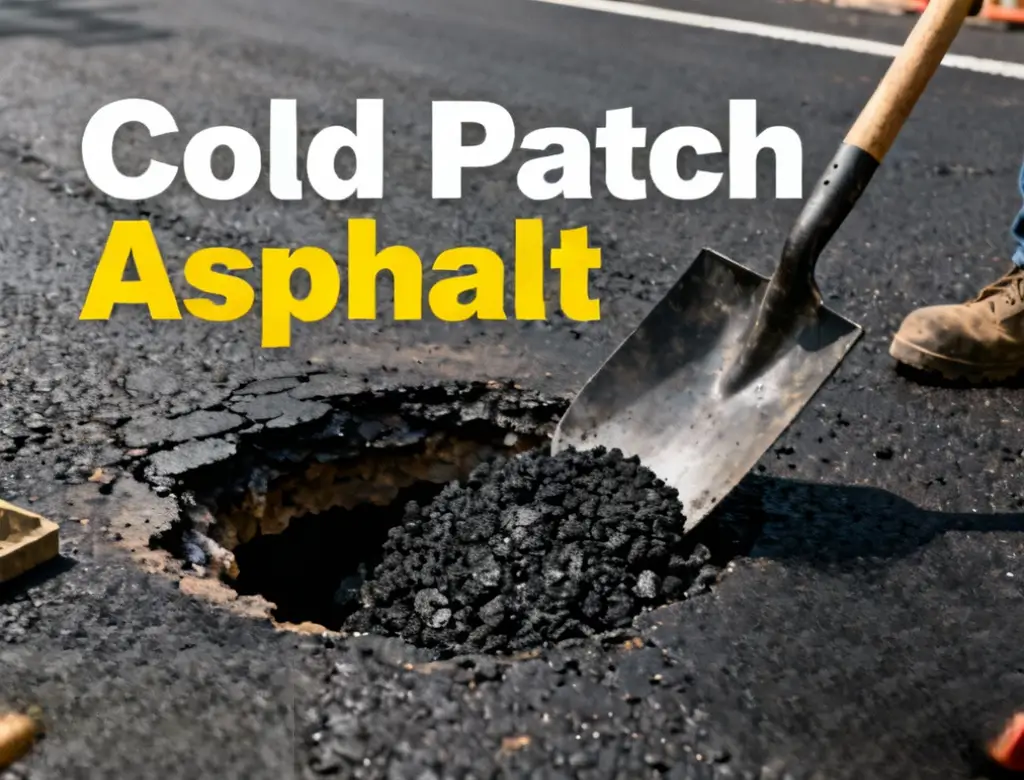
In stark contrast to HMA, cold patch application is simple, fast, and requires minimal labor and equipment. For most repairs, the only tools needed are a shovel and a hand tamper or a small, walk-behind plate compactor.
2. Installation Process (Best Practices)
While application is simple, the longevity of the patch is directly dependent on following proper installation procedures.
- Clean: Remove all loose debris, failed asphalt, rocks, and standing water from the hole.
- Prepare: For a high-performance, permanent repair, the edges of the pothole should be “squared up” with a pavement saw to create vertical sides for the patch to bond to.
- Fill: Shovel the cold mix material into the hole in 2-inch “lifts” (layers).
- Compact: Thoroughly compact each 2-inch lift with a tamper before adding the next. Overfill the final lift to create a 1/2-inch “crown” above the existing pavement. This crown allows for future compaction from traffic, which will settle the patch flush with the road surface.
3. “Throw-and-Go” vs. Best Practice
How long a cold patch lasts depends more on the installation method than the material itself. The common “throw-and-go” method—simply shoveling material into an unprepared hole and compacting it with the back of a shovel—is fast and cheap but will fail quickly, as the patch will not bond and will break apart or come loose. Following the best-practice method (cleaning, squaring, compacting in lifts) is necessary for a long-lasting, permanent repair, especially when using high-performance PM mixes.
4. Application: Potholes vs. Utility Cuts
These two applications present different challenges. A pothole repair involves filling a disintegrated area. A utility cut is a full-depth trench dug to access underground pipes or cables. For a utility cut patch to succeed, the base material in the trench must be backfilled and properly compacted in lifts before the cold patch is applied. If the base is not compacted, the patch will sink and subside, regardless of the patch material’s quality.
D. Cold Patch All-Weather Capabilities
This is the primary logistical advantage of cold patch. It is specifically formulated to be used in the adverse conditions where HMA application is impossible. High-quality cold patch can be applied in cold, freezing, and wet conditions. Many proprietary mixes are formulated with hydrophobic additives that actively displace water, allowing them to bond to a wet, cold surface. This makes cold patch the only tool available to a public works director for emergency repairs during a winter freeze-thaw cycle.
E. Curing and Traffic Readiness Comparison
HMA: HMA does not “cure” in a chemical sense; it hardens by cooling. Traffic must be prohibited until the mat has cooled below a specific temperature (e.g., 160°F) to prevent rutting or shoving. This typically takes a minimum of 24 to 48 hours. Full binder solidification and strengthening can take 30 to 90 days.
Cold Patch: The time to traffic readiness depends entirely on the binder technology.
- Evaporation-Cured (Cutback/Emulsion): Requires a 24- to 48-hour curing period for the solvents or water to evaporate. The patch can remain soft and sticky, especially in hot weather, until this process is complete.
- Compaction-Cured (HP Mixes): Can be opened to traffic immediately after compaction. The weight of vehicles helps complete the compaction process.
Table 3 provides a summary of the application and curing constraints:
| Factor | Hot Mix Asphalt (HMA) | Warm Mix Asphalt (WMA) | Cold Patch (Evaporation-Cured) | Cold Patch (HP Compaction-Cured) |
|---|---|---|---|---|
| Required Equipment | Paver, Rollers, Trucks | Paver, Rollers, Trucks | Shovel, Hand Tamp | Shovel, Hand/Plate Tamp |
| Typical Crew Size | 5–10 | 5–10 | 1–2 | 1–2 |
| Min. Ambient Temp | ≈ 45°F – 60°F | ≈ 32°F – 50°F | ≈ 40°F | No min. (e.g., -5°F) |
| Min. Surface Temp | ≈ 45°F – 60°F | ≈ 32°F – 50°F | Dry, ≈ 40°F | No min., can be wet |
| Moisture/Rain | Prohibited | Prohibited | Not recommended | Tolerated |
| Curing Mechanism | Thermal Cooling | Thermal Cooling | Evaporation | Compaction |
| Time to Traffic | 24–48 Hours | 24–48 Hours | 24–48 Hours | Immediate |
V. Performance, Durability, and Life-Cycle Analysis
A. Durability and Structural Longevity
HMA: As a pavement system, HMA is designed for structural longevity. It provides high load-bearing capacity and flexibility to distribute heavy traffic loads. A well-designed, constructed, and maintained HMA pavement has a typical service life of 15 to 30 years.
Conventional Cold Patch: This material is, by its chemical nature, a temporary fix. Its service life is measured in months, and it is common for patches to fail after one season or less, especially in high-traffic areas. It lacks the structural integrity and binder strength of HMA.
High-Performance (PM) Cold Patch: As shown, these materials are designed for permanent repair. Their polymer-enhanced binders provide long-term durability, better flexibility, and strong adhesion. When installed correctly, these patches can last for many years, often lasting until the surrounding pavement itself fails.
B. Performance in Adverse Conditions (Freeze-Thaw and Moisture)
The primary mechanism for pothole formation is water penetrating the HMA, freezing and expanding, and then thawing, which leaves a void and breaks the pavement apart under traffic. HMA itself is vulnerable to this moisture damage.
Cold patch, on the other hand, is designed to work in this environment. Its binders are often made to repel water. High-performance polymer mixes, in particular, show excellent resistance to freeze-thaw cycles and moisture damage, making them a durable solution for repairs in wet, cold climates. In other words, HMA’s main failure cause (water/ice) is exactly why we need cold patch, and the best cold patch materials are designed to be stable in those same conditions.
C. Analysis of Common Failure Modes
The typical failure modes for each material show their basic nature. HMA fails as a pavement system, while cold patch fails as a local repair.
1. HMA Failure Modes
- Fatigue (Alligator) Cracking: Interconnected cracks resembling alligator skin, caused by structural failure of the pavement under repeated traffic loads.
- Thermal (Transverse) Cracking: Cracks that form perpendicular to the road’s centerline, caused by the pavement’s inability to contract during extreme cold.
- Rutting & Shoving: Permanent, plastic deformation in the wheel paths (ruts) or as ripples across the surface (shoving). This is caused by a weak mix design, insufficient compaction, or a failing subgrade.
2. Cold Patch Failure Modes
- Raveling: The aggregate particles strip away from the binder, causing the patch to disintegrate from the top down. This is the most common failure, typically caused by a weak binder or, most often, poor compaction during installation.
- Dishing/Subsidence: The patch sinks below the level of the surrounding pavement. This is almost always caused by improper compaction—either of the patch material itself (in 2-inch lifts) or, in a utility cut, of the base material beneath the patch.
- Edge Failure/Disbonding: The patch breaks away at the edges or lifts out of the hole entirely. This is a bonding failure, usually caused by attempting to patch a dirty, dusty, or debris-filled hole, or by poor-quality binder.
VI. Economic and Environmental Analysis
A. Comparative Cost Analysis
The economics of HMA versus cold patch are inverted. HMA has a low material cost but a high installed cost. Cold patch has a high material cost but a low installed cost.
1. Material Costs
- HMA: $40 – $100 per ton
- Cold Mix (Bulk): $90 – $175 per ton
- Cold Mix (Bag): $8 – $30 per 50-lb bag
On a per-pound basis, the proprietary oils, additives, and polymers in high-performance cold mix make it 50% to 100% more expensive as a material than HMA.
2. Installed Costs
- HMA (New Paving): $3 – $4 per square foot
- HMA (Saw-Cut Patch): $2.50 – $8.00 per square foot
- Cold Patch Repair: $2 – $5 per square foot
3. Total Project Cost
The “per square foot” numbers can be misleading. The critical differentiator is mobilization.
HMA: The material cost is a small fraction of the total project cost, which is dominated by the mobilization of heavy equipment ($100,000+ paver, $30,000+ rollers) and large crews ($100s per hour). The minimum charge for an HMA crew to patch a few small areas can be thousands of dollars.
Cold Patch: The total project cost is dominated by the material cost. Labor and equipment (one truck, one worker, one $50 tamper) are minimal.
For large-scale paving, HMA’s low material cost makes it the only economical choice. For small, scattered repairs, cold patch’s low mobilization cost makes it the only economical choice.
B. Life-Cycle Cost (LCC) Modeling
Life-Cycle Cost (LCC) is the most critical metric for an asset manager.
Scenario 1 (Conventional Cold Patch): This “throw-and-go” approach has a very low initial cost but a very short lifespan (less than 1 year). This creates a costly cycle of re-patching every year, which has a very high long-term cost due to repeated labor, material, and traffic control costs. This appears cheap but costs more in the long run.
Scenario 2 (HMA Patch): This has a very high initial cost due to equipment mobilization but a very long lifespan. This is a permanent solution but is often unavailable in winter and too expensive for small repairs.
Scenario 3 (High-Performance PM Cold Patch): This has a moderate initial cost (higher material, low labor) and a long lifespan (5-10+ years).
The best long-term cost strategy for maintenance repairs is Scenario 3. Paying 50% more for a high-performance PM cold patch that lasts 5-10 times longer than a conventional patch greatly reduces the long-term budget by eliminating 5-10 cycles of labor, equipment, and traffic control costs.
C. Environmental Footprint
HMA: High energy consumption and carbon footprint due to the fossil fuels required to heat aggregates to 300°F+.
WMA: This is the “green” paving solution. By lowering production temperatures, it significantly reduces fuel consumption, energy use, and emissions.
Cold Mix (Cutback): Extremely poor environmental performance. The evaporation of petroleum solvents releases high levels of toxic, smog-forming VOCs.
Cold Mix (Emulsion/HP): Excellent environmental performance. Emulsion mixes are water-based, and HP mixes use non-volatile oils, resulting in low or zero VOC emissions. Their room temperature application also means minimal energy use.
The environmental choice is clear: for paving, WMA is the better choice. For patching, emulsion-based or high-performance, compaction-cured mixes are the better choice.
VII. Final Analysis and Professional Recommendations
A. Synthesizing the Data
The choice between Hot Mix Asphalt and Cold Patch Asphalt is not a competition, but a situational engineering decision based on scale, application, and season.
Hot Mix Asphalt (HMA) is the structural asset. It is the only material suitable for new construction, pavement overlays, and full-depth structural rehabilitation. Its high-heat, plant-based manufacturing and weather-dependent application define it as a large-scale, seasonal construction material.
Cold Patch Asphalt is the maintenance tool. It is the only material suitable for rapid, small-scale, all-weather repairs. Its primary function is to preserve the HMA asset by preventing water intrusion and the expansion of potholes, especially during the winter months when HMA is unavailable.
B. The Importance of Choosing the Right Type
The most important takeaway for any engineer, asset manager, or purchasing agent is choosing the correct type of cold patch. The data clearly shows a huge performance and cost difference between cheap, temporary, evaporation-cured mixes and durable, permanent, polymer-modified, compaction-cured materials.
Recommendation: Conventional cold patch should be used only as a temporary “throw-and-go” fix to address an immediate safety issue, with the full expectation of replacing it in the next paving season. For any repair intended to last, a high-performance, polymer-modified, compaction-cured cold patch should be used. The higher initial material cost is well justified by the major savings in long-term labor, equipment, and traffic control costs.
C. Pavement Management Decision Matrix
Table 5 provides a clear decision matrix for common pavement management scenarios:
| Pavement Scenario | Recommended Material | Primary Justification & Key Considerations |
|---|---|---|
| New Highway / Parking Lot Construction | Hot Mix Asphalt (WMA preferred) | Justification: Structural integrity, load-bearing capacity, lowest LCC for new build. Consideration: WMA is preferred for reduced emissions and improved compaction. |
| Full-Depth Structural Repair (Large Area) | Hot Mix Asphalt (Saw-Cut Repair) | Justification: Restores full structural integrity; permanent bond; highest quality repair. Consideration: Only feasible during paving season; high mobilization cost. |
| Emergency Winter Pothole (High Traffic) | High-Performance (HP) PM Cold Patch | Justification: All-weather application (cold/wet); immediate traffic readiness; high durability. Consideration: Must be compaction-cured. |
| Non-Emergency Pothole (Summer) | HP/PM Cold Patch or HMA Repair | Justification: PM Patch offers lowest installed cost and speed. HMA patch offers maximum durability if a crew is already mobilized for a larger project. |
| Utility Cut / Trench Repair | High-Performance (HP) PM Cold Patch | Justification: Provides a permanent repair without HMA mobilization cost; faster project completion. Consideration: Requires stringent compaction of the sub-base and the patch in 2” lifts to prevent subsidence. |
| Temporary “Throw-and-Go” Fix | Conventional Emulsion Cold Patch | Justification: Lowest initial material cost; addresses immediate safety hazard. Consideration: Must be scheduled for replacement. High long-term LCC. |
| (Banned Specification) | Cutback Asphalt Cold Patch | Justification: Environmentally harmful (high VOCs); poses health risks; technologically obsolete. |
Conclusion
Understanding the key differences between Hot Mix Asphalt and Cold Patch Asphalt is essential for making informed paving and repair decisions. While HMA remains the best option for structural paving and new construction, modern high-performance cold patch materials offer a cost-effective, environmentally friendly, and durable solution for maintenance and repair work. By choosing the right material for each specific application and following best practices for installation, property owners and managers can get the best performance and lowest long-term costs while maintaining safe, functional pavement surfaces year-round.