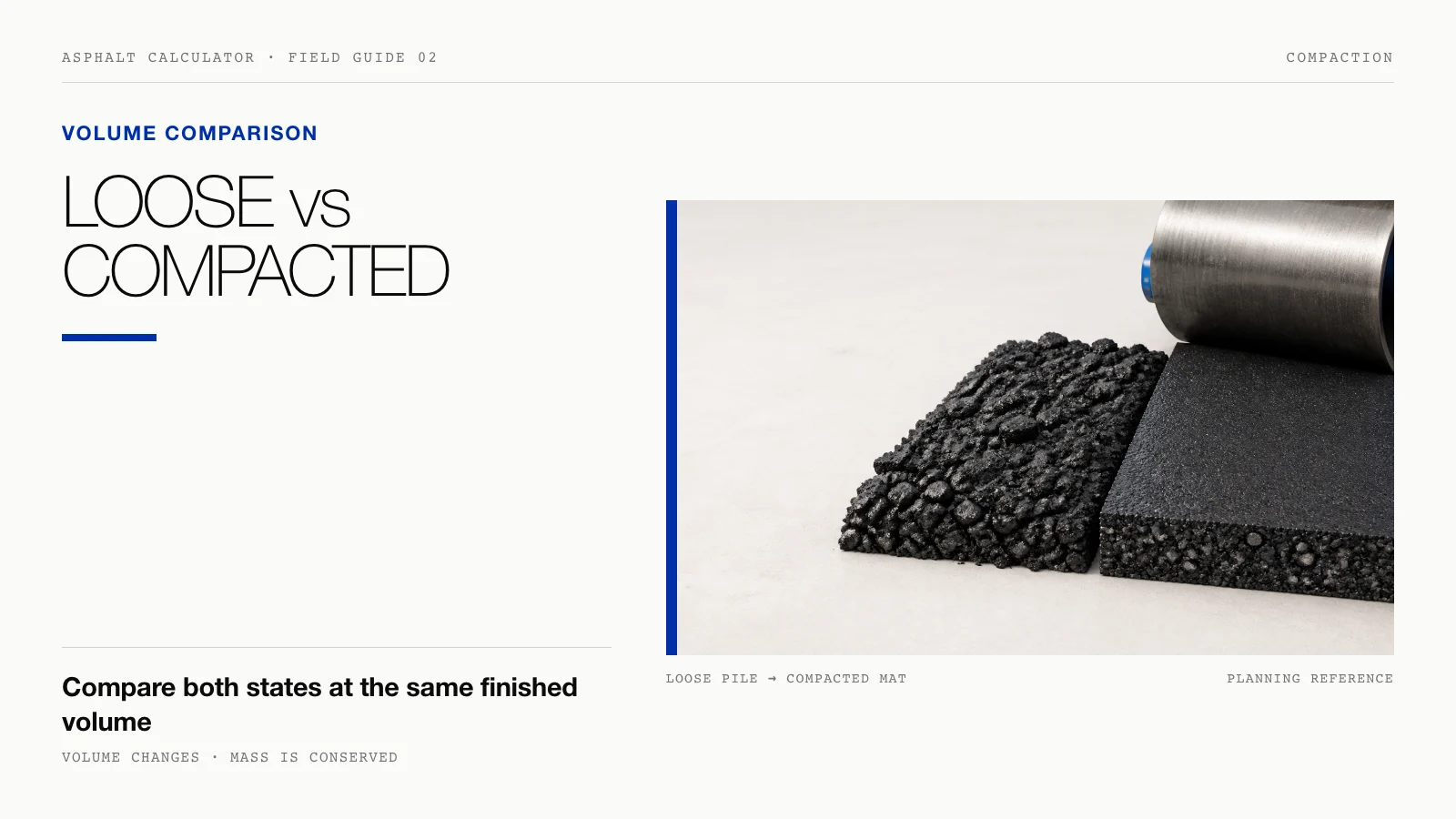
Loose asphalt and compacted asphalt describe different material conditions. A truck or uncompacted mat contains more air space; rolling reduces air voids and volume while increasing in-place density. The finished layer is normally specified and measured using compacted thickness.
For quantity estimating, keep the volume and density basis consistent:
- Compacted thickness pairs with compacted density.
- Loose volume pairs with a verified loose bulk density.
- Do not add a separate compaction multiplier merely because the material will be rolled if the original calculation already uses compacted inputs.
What compaction changes
FHWA describes compaction as compressing asphalt mixture, reducing its volume and air voids, and increasing its unit weight or density. See the FHWA in-place pavement density report.
Compaction does not create mass. It changes how the mixture’s mass occupies space. A quantity estimate based on finished area, finished compacted thickness, and compacted density already represents the mass required in that finished volume.
The double-counting problem
Consider 1,000 sq ft at a finished 2-inch thickness and an assumed compacted density of 145 lb/ft³:
Compacted volume = 1,000 × 2 ÷ 12 = 166.67 ft³
Weight = 166.67 × 145 = 24,166.7 lb
Base quantity = 12.08 US tons
If an estimator then multiplies 12.08 tons by an arbitrary “1.25 compaction factor,” the result becomes 15.10 tons. That extra 25% was not derived from measurements, mix behavior, or supplier data; it counted compaction twice.
This does not mean an order can never exceed the calculated base quantity. It means any allowance should be tied to separate causes such as irregular geometry, leveling, measurement uncertainty, equipment residue, supplier minimums, or load rounding.
Loose lift thickness is not universal
Estimators sometimes use a rule such as “place a certain loose depth to obtain a smaller compacted depth.” The relationship can vary with mixture, equipment, temperature, lift thickness, support, and rolling pattern. Treat a loose-to-compacted ratio as construction-process information supplied by the contractor or specification, not as a universal material constant.
The quantity calculation should remain anchored to the finished requirement:
- Measure net finished area.
- Enter the required compacted thickness.
- Use project-specific compacted density.
- Calculate base weight.
- Add only a documented ordering allowance.
Loose stockpile or truck-volume problems
Sometimes the known quantity is a loose volume rather than a finished layer. In that case, use a loose bulk density that matches the material and condition:
Loose weight = loose volume × verified loose bulk densityDo not use the finished compacted density unless the volume is also compacted. For reclaimed material, source and gradation can introduce additional variation; FHWA’s RAP guidance treats reclaimed asphalt in plant mixtures, granular base, and other applications as distinct engineering uses.
Compacted thickness measurement
The calculator cannot verify construction thickness. Plans, cores, yield checks, survey information, and quality-control procedures may all be relevant depending on the job. Average thickness also does not describe local thin spots, grade corrections, or variable leveling needs.
If a project has separate surface and binder lifts, calculate each lift independently. The parking lot asphalt calculator keeps the two weights separate.
Common estimating errors
- Entering loose depth where the form asks for compacted thickness.
- Using compacted density with loose truck or stockpile volume.
- Applying both a “compaction factor” and an ordering allowance to the same uncertainty.
- Assuming one rolling ratio works for every mix and lift.
- Treating quantity arithmetic as pavement design.
A clean estimate record
Document these fields so another person can reproduce the estimate:
| Field | Example record |
|---|---|
| Area | measured net paved area |
| Thickness | finished compacted thickness by lift |
| Density | value, unit, source, and material condition |
| Base quantity | formula result before allowance |
| Allowance | percentage plus written reason |
| Order quantity | base quantity × allowance multiplier |
Use the main asphalt calculator to expose the full calculation, then read the asphalt waste-factor guide before deciding whether any extra quantity is justified.