Scope: This page is a visual screening framework for deciding what to investigate next. The “30% rule” is a budgeting heuristic, not an engineering standard. Drainage, cores, base condition, traffic, and local specifications can change the correct treatment.
1. Executive Summary and Engineering Context
For both homes and commercial properties, an asphalt driveway is a flexible pavement system, not just a black surface on the ground. From top to bottom, this system usually has three layers:
- Asphalt Surface: Bituminous concrete – the black wearing layer you see.
- Aggregate Base: Compacted crushed stone that spreads loads.
- Subgrade: The native soil that ultimately carries everything.
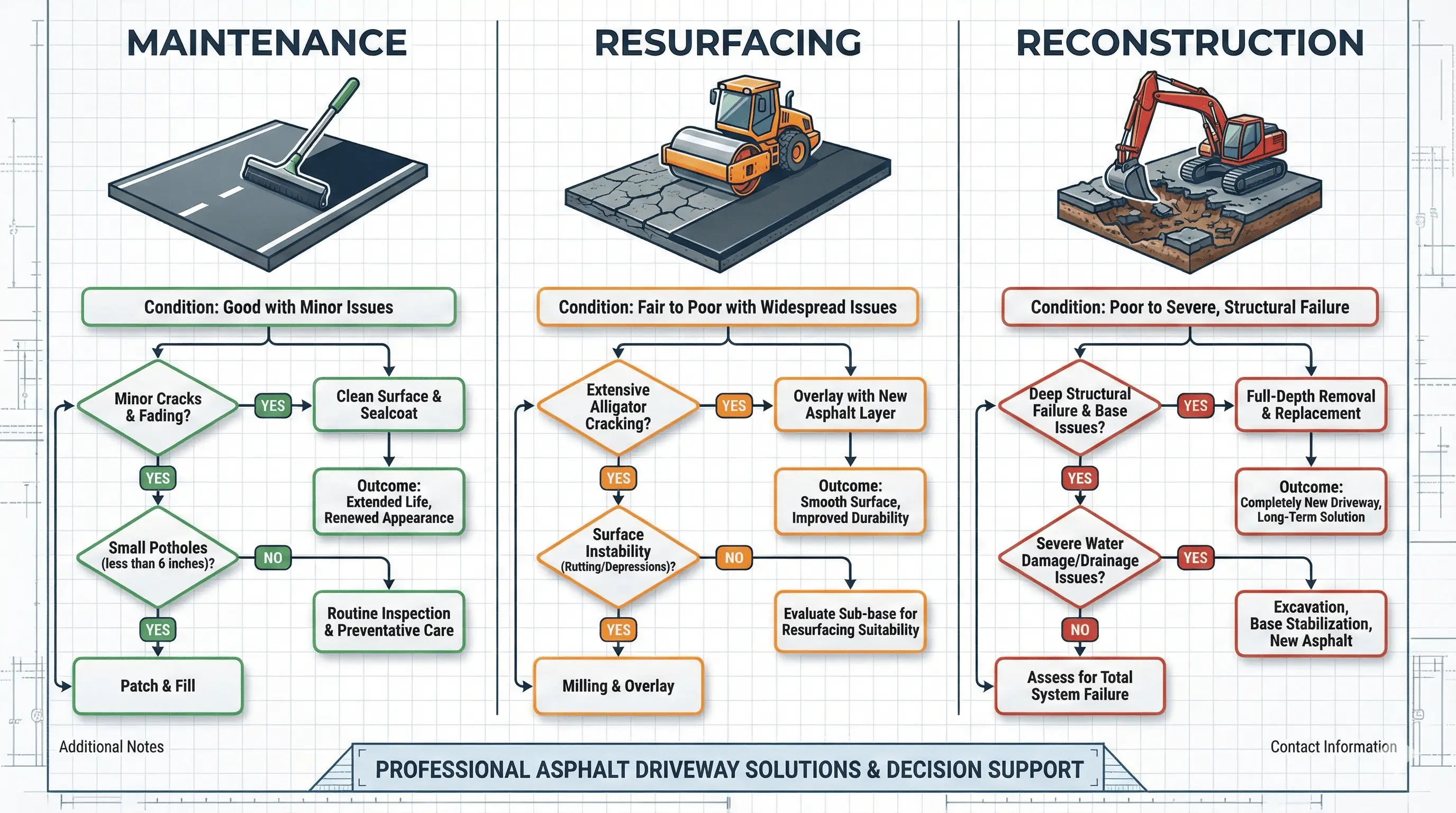
When a driveway starts to fail, you usually have three main options:
- Localized Repair (patching, crack repair)
- Resurfacing / Overlay (new asphalt layer over the old one)
- Full-Depth Reconstruction (tear-out and rebuild from the base up)
The key engineering and cost question is when to stop repairing and start replacing. Damaged-area percentage is useful for comparing alternatives, but there is no universal 30% engineering standard. Distress depth, base stability, drainage, access, future loading, and unit prices can move the economic crossover substantially.
This article explains the decision process using clear language, while keeping core professional terms like Alligator Cracking, Reflective Cracking, Life Cycle Cost Analysis (LCCA) and Subgrade accurate.
1.1 Intervention Level System
Driveway maintenance is not a yes/no decision. In practice, engineers think in tiers of intervention based on how badly the pavement has degraded.
Intervention Levels Overview
| Tier | Intervention Level | Typical Methods | Primary Indications | Est. Life Extension | 2025 Cost Est. (per sq ft) |
|---|---|---|---|---|---|
| 1 | Preventive Maintenance | Appropriate crack treatment and surface treatment | Early surface distress; support and drainage remain sound | Condition-dependent | Low relative scope |
| 2 | Localized Repair | Partial- or full-depth patching | Isolated failure with definable limits | Project-dependent | Medium unit cost |
| 3 | Resurfacing | Leveling, milling, interlayer where designed, overlay | Surface distress with adequate support and correctable profile | Project-dependent | High intervention |
| 4 | Reconstruction | Removal, drainage/base correction, new pavement | Widespread structural failure or support/drainage deficiency | Resets pavement structure | Highest intervention |
Note: Costs are broad U.S. 2025 estimates and vary significantly by region and oil prices.
2. Pavement Pathology: How to Read the Damage
Correct diagnosis is critical. In simple terms, we need to know if the problem is mainly:
- Environmental / top-down (sun, water, temperature)
- Structural / bottom-up (weak base, poor subgrade, heavy loads)
2.1 Alligator Cracking: Clear Signal of Structural Failure
Alligator Cracking (Fatigue Cracking) looks like reptile skin or chicken wire – a tight pattern of interconnected cracks.
- Mechanism (what is happening): This is a load-related structural failure.
- Repeated vehicle loads create tensile stress at the bottom of the asphalt layer.
- If the base is weak or the asphalt is too thin, cracks start at the bottom and move upward (bottom‑up cracking).
- Implication: You cannot fix alligator cracking with simple crack seal or a thin overlay.
- If you place a new layer over unresolved fatigue cracking, movement can reflect through the overlay. Timing varies with structure, traffic, climate, preparation, and overlay design.
- Decision implication: Widespread alligator cracking makes reconstruction increasingly competitive, but test pits, cores, proof rolling, or other investigation may be needed to define how much support has failed.
2.2 Linear Cracks: Longitudinal and Transverse
Linear cracks are cracks that run in straight or nearly straight lines.
- Transverse Cracks: Run across the driveway, perpendicular to traffic.
- Often caused by thermal shrinkage – the asphalt gets brittle in cold weather and contracts.
- Longitudinal Cracks: Run along the length of the driveway.
- Often appear at construction joints or edges with poor support.
These cracks are often environmental, not full structural failure.
- Repair Potential:
- Narrow linear cracks (typically < 1/2 inch) are good candidates for Crack Filling or Crack Sealing.
- Wider cracks or ones combined with settling or edge breakup may require localized patching.
- By themselves, they do not always mean the whole pavement system has failed.
2.3 Block Cracking and Oxidation
Block Cracking breaks the pavement into large, roughly rectangular blocks.
- Cause: Usually aging and hardening of the asphalt binder (oxidation), not overloading.
- What it means: The asphalt surface has lost flexibility, but the base can still be stable.
- Decision: When blocks are large and the driveway still feels structurally sound (no pumping, no major movement), a Resurfacing (Overlay) is often an excellent way to restore the wearing surface and extend life.
3. The Decision Model: Repair vs. Replace
To keep decisions objective, many engineers and contractors use a simple model based on:
- The 30% damage threshold, and
- The age of the driveway.
3.1 Use damaged area as a cost input, not a golden rule
As the area requiring full-depth patches grows, reconstruction can become more economical because patching has high unit costs and leaves adjacent aged pavement in service. Calculate the crossover for the actual project instead of assuming one percentage.
Why the crossover matters:
- Heavy patching is expensive per square foot.
- Extensive patching retains old pavement between repaired areas, so the owner may pay a large share of reconstruction cost without resetting drainage, profile, and remaining service life.
3.2 Age is context, not a replacement trigger
Older pavement has had more time to oxidize, accumulate utility cuts, and experience loading, but age does not reveal base condition by itself. A sound older pavement can remain an overlay candidate; a young pavement can require reconstruction after drainage or support failure. Use age to interpret records and remaining-risk uncertainty, not as an automatic decision rule.
3.3 Drainage Assessment
Water is asphalt’s number one enemy.
- “Birdbaths”: Depressions that hold water after rain.
- These usually indicate subgrade or base settlement.
- Why this matters:
- Overlays cannot permanently fix poor grading or standing water.
- Fixing drainage typically requires regrading the base and sometimes the subgrade.
- This is a Tier 4 (Reconstruction) type problem, not a surface-only problem.
3.4 Decision Matrix: Repair vs. Resurface vs. Reconstruct
Use the following matrix as a quick screening tool:
| Evaluation Dimension | Repair (Seal / Fill) | Resurface (Overlay) | Reconstruct (Replace) |
|---|---|---|---|
| Pavement Age | Context only; newer pavement may still fail | Context only; condition controls | Context only; age alone does not require replacement |
| Damaged Area | Isolated and shallow | Surface distress with limited deep repair | Widespread deep repair or connected failure |
| Crack Type | Linear (< 1/2”), minor surface flaws | Block cracking, raveling, shallow fatigue | Alligator cracking, deep fissures, widespread failures |
| Base Condition | Stable | Mostly stable | Unstable, soft spots, sinking areas |
| Drainage | Good | Good or minor issues | Poor (standing water, birdbaths, negative slope) |
4. Tier 1 & 2: Maintenance and Repair Technologies
4.1 Sealcoating: What It Does and How It Works
Sealcoating is a thin protective coating applied to the surface of the asphalt. It helps shield the pavement from UV rays, water, and oil/chemical drips.
2025 Sealant Comparison
| Type | Durability (Typical) | Chemical Resistance | Notes & Risks |
|---|---|---|---|
| Coal-tar-based | Product-specific | Product-specific | PAH concerns have led to restrictions in some jurisdictions; check local rules and site policy. |
| Asphalt emulsion | Product-specific | Product-specific | Review solids, preparation, cure, local rules, and pavement compatibility. |
| Acrylic | Product-specific | Product-specific | Often selected for color or specialty use; verify traffic and substrate suitability. |
Sealcoat pricing and suitability vary by product, preparation, project size, and jurisdiction. It is a surface treatment, not a repair for structural cracking.
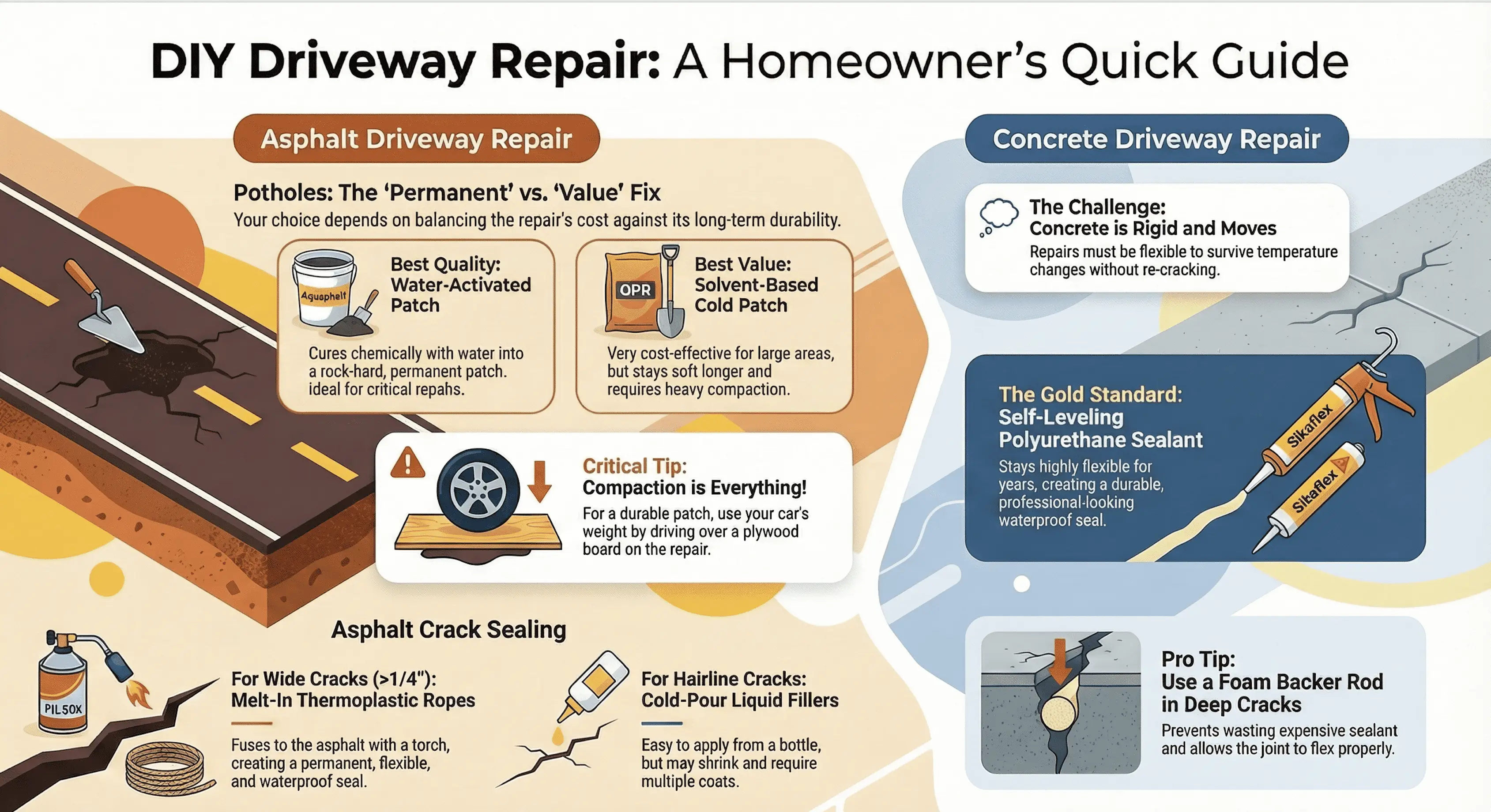
4.2 Crack Repair
Two key ideas:
- Crack Filling vs. Crack Sealing:
- “Working” cracks that open and close with temperature changes need flexible, rubberized sealant.
- Static cracks (little movement) can often be filled with stiffer asphalt emulsions.
- Infrared Repair:
- The existing asphalt is heated to around 350°F, raked, rejuvenated with new oil, and then re-compacted.
- This creates a more seamless repair and avoids cold joints between new and old material.
5. Tier 3: Surface Resurfacing (Overlay)
Resurfacing means placing a new layer of hot mix asphalt, usually 1.5–2 inches thick, on top of the existing pavement.
5.1 The Risk of Reflective Cracking
Reflective Cracking happens when existing cracks in the old pavement work their way up through the new overlay.
- Without proper preparation, this can happen in as little as 1 year.
- To slow or reduce reflective cracking, contractors can install geotextile paving fabrics (fabric interlayers) between the old surface and the new overlay to absorb stress.
5.2 Mill and Overlay vs. Standard Overlay
-
Standard Overlay:
- New asphalt is paved directly on top of the existing surface.
- This raises the grade of the driveway.
- Risks: May block drainage, reduce curb height, or create trip edges at garage entries.
- Cheaper up front but often less ideal long term.
-
Mill and Overlay:
- The top 1–3 inches of old asphalt are milled off (ground down) first.
- This step removes surface damage and allows the contractor to restore proper slope and elevation.
- The new layer then matches the original height at garages, sidewalks, and curbs.
- Usually the preferred method for longevity and good drainage.
6. Tier 4: Full Reconstruction
When the base or subgrade has failed, surface-level fixes will not last. At this point, only full reconstruction is appropriate.
6.1 The Reconstruction Stack (Typical Section)
A standard reconstruction sequence looks like this:
- Demolition: Remove existing asphalt and any unstable base material.
- Subgrade Preparation: Shape and compact the native soil.
- Aggregate Base Installation: Install about 4–8 inches of compacted crushed stone.
- Compaction and acceptance should follow the specified material, test method, lift thickness, and project requirements.
- Binder & Surface Course: Place new hot mix asphalt, typically 2–3 inches compacted thickness.
6.2 Estimate the alternatives on the same scope
Price repair, overlay, and reconstruction using the same project limits, drainage assumptions, mobilization, and analysis period. Local itemized bids are more meaningful than broad national square-foot ranges.
7. Supplier Management: Avoiding Common Scams
Unfortunately, the paving industry has some recurring scams targeting homeowners. Knowing the patterns helps you avoid bad actors.
7.1 The “Leftover Asphalt” Scam
The classic story:
- A contractor knocks on your door claiming they have “leftover asphalt” from a nearby job and can give you a “great deal today only”.
Reality:
- Asphalt must be placed hot (around 275–300°F) to compact correctly.
- “Leftover” asphalt is usually too cool and will not compact well, leading to early failure.
- Legitimate contractors plan their loads and do not drive around trying to sell leftovers door-to-door.
7.2 The “Lipstick on a Pig” Overlay
Another scam is offering a thin overlay on a driveway that already has severe alligator cracking or base failure.
- It may look good for a few weeks, but because the base is broken, the new surface will fail quickly after you pay.
- In the trade, this is often called “Lipstick on a Pig” – it hides the problem for a short time but does not fix it.
8. Conclusion: Turning Engineering into Simple Rules
Choosing between repair, resurfacing, and full replacement is ultimately an exercise in smart resource allocation.
To keep it simple, remember these four rules:
- Analyze the Cracks: If it looks like alligator skin, you probably need more than just patching – often a new driveway.
- Respect the Age: If the driveway is over 20 years old, heavy investment in repairs or overlays is often not a good long-term bet. Reconstruction usually makes more sense.
- Watch the Water: If you see standing water or obvious drainage problems, surface-only fixes will not last. You need to address the grading and base.
- Verify the Contractor: Avoid door-to-door offers and insist that contracts specify important technical details like “compacted thickness” of asphalt and base, not just loose thickness.
Appendix: Asphalt Decision & Maintenance Expansion
I. Anatomy of a Driveway
- Surface Course: The black wearing layer (asphalt surface).
- Base Course: The structural layer of compacted stone.
- Subgrade: The native soil that supports the whole system.
II. Diagnostics Checklist
- Visual ID: Learn to tell the difference between Alligator Cracking, Block Cracking, and Linear Cracks.
- Drainage Audit: Look for negative slope toward the house and birdbaths (standing water) after rain.
III. Repair Technologies Snapshot
- Crack Sealing: Rubberized hot‑pour sealant for working cracks.
- Crack Filling: Stiffer materials for less active cracks.
- Patching:
- Cold Patch: Temporary, convenient but not long-term.
- Hot Patch: Permanent repair using hot mix asphalt.
- Infrared Repair: Heats and blends existing asphalt for seamless joints.
IV. Advanced Interventions
- Geotextiles / Paving Fabrics: Installed between old and new layers to help control Reflective Cracking.
- Milling: Removes the damaged top layer and restores proper slope before placing new asphalt.
V. Consumer Protection
- Scam Awareness: Be cautious of “leftover asphalt” offers and “one-day only” deals that pressure you to decide immediately.
- Contract Essentials:
- Written warranty terms.
- Specified compacted thickness of asphalt and base.
- Clear drainage and grading responsibilities.
Sources and related guides
Use the asphalt-on-asphalt overlay guide when the existing pavement may support an overlay, test local scope with the asphalt resurfacing cost calculator, or use the DIY rehabilitation guide for localized homeowner repairs.