Asphalt maintenance works best as a routine instead of a reaction. Small, inexpensive treatments applied while the pavement is still sound tend to protect it longer than waiting until damage spreads. This guide gives a season-by-season schedule for a residential asphalt driveway or small lot, with the decision points and quantities that matter.
The principle: treat pavement while it is still sound
Highway agencies call this approach pavement preservation. The Federal Highway Administration described preventive maintenance as a planned strategy of cost-effective treatments applied to pavement that is still structurally sound, to extend its service life without significantly increasing its structural capacity.
Two practical consequences follow:
- Surface treatments do not fix structural failure. Sealcoat and crack sealing protect a sound pavement. They cannot rebuild a failed base.
- Timing matters more than product choice. The same treatment helps a pavement in good condition and does little for one that is already breaking up.
Asphalt maintenance schedule at a glance
| When | What to do | Why |
|---|---|---|
| First months after paving | Avoid sharp turns with stationary wheels, heavy point loads, and parking on the edges, especially in hot weather | New asphalt is softer and easier to scuff or deform |
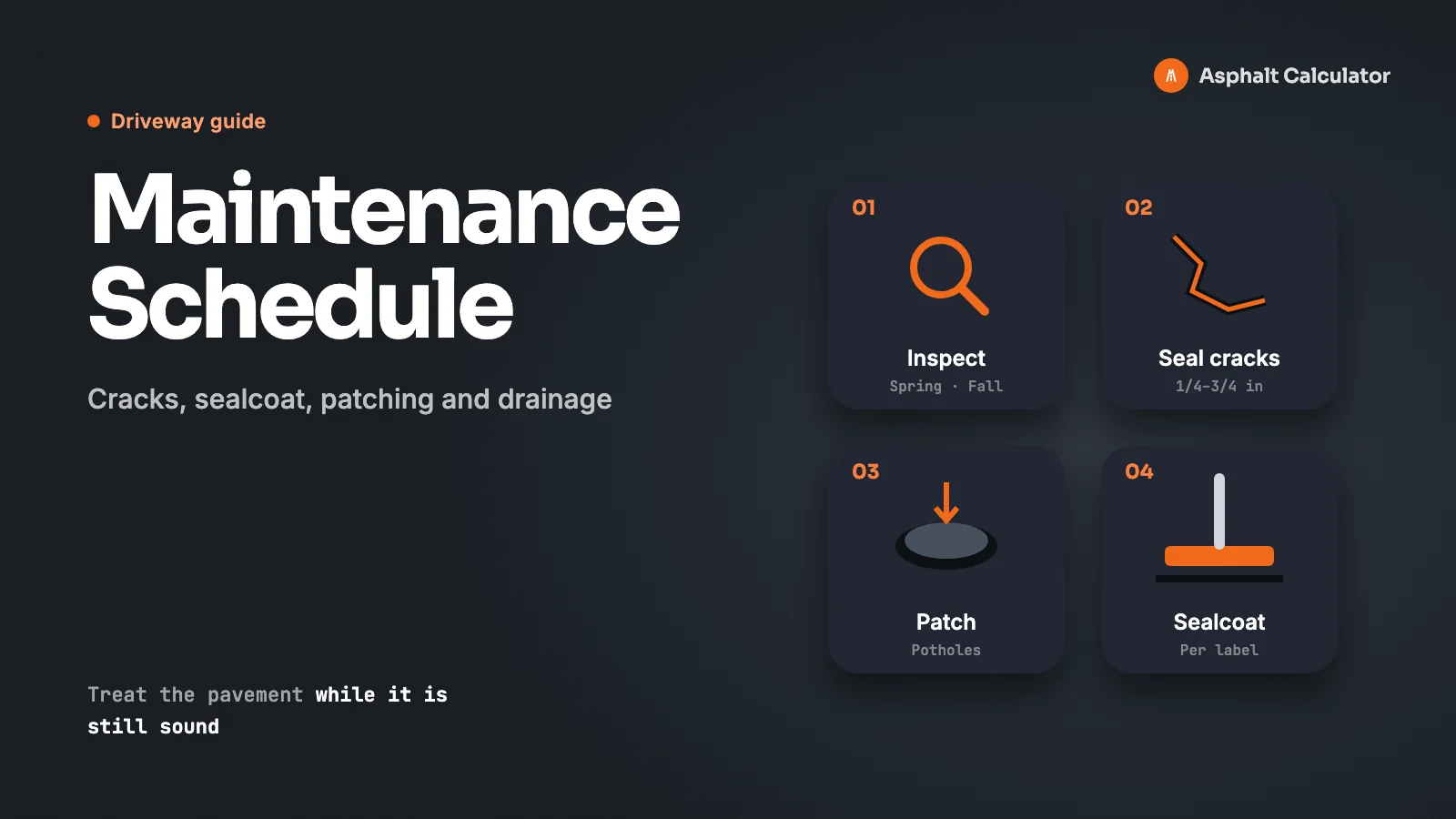
| Every spring and fall | Walk the surface: cracks, edges, low spots, standing water, vegetation, stains | Catch problems while they are small |
| When cracks appear | Seal or fill cracks in the appropriate width range | Keeps water out of the base |
| When potholes or failed spots appear | Patch promptly | Stops the damage from spreading |
| On the interval the product and condition call for | Sealcoat after repairs are done | Protects the surface from weathering and spills |
| When distress is widespread | Evaluate resurfacing or reconstruction | Maintenance no longer pays back |
The exact interval for each task depends on climate, traffic, drainage, and the condition of the pavement. Use the schedule as a checklist, not a fixed calendar.
Spring and fall inspection checklist
- Cracks: note width, length, and whether they are single lines or interconnected “alligator” patterns.
- Edges: look for crumbling or cracking along unsupported edges.
- Low spots and standing water: water that stays on the surface or soaks the edges weakens the base.
- Drainage paths: clear gutters, downspout outlets, and channels that discharge onto or under the pavement.
- Vegetation: remove plants growing in cracks or along the edges, then treat the crack.
- Stains: clean oil, fuel, and solvent spills promptly. Petroleum products can soften asphalt binder.
- Previous repairs: check whether patches and crack sealant are still bonded.
Write the findings down with dates. A simple record makes it easier to plan work and budget, as explained in the driveway ownership cost guide.
Cracks: seal, fill, or repair?
Crack width is the main deciding factor. An FHWA manual of practice for crack treatments, as summarized in a 2025 National Academies synthesis, gives these ranges:
| Crack width | Typical treatment |
|---|---|
| About 1/4 to 3/4 inch, working (opens and closes with temperature) | Crack sealing |
| About 1/4 to 1 inch, little movement | Crack filling |
| Wider cracks, or cracks with broken edges | Other repair methods, such as patching |
FHWA classified crack sealing as a preventive treatment, and crack filling of non-working cracks as routine maintenance. For a driveway, the point is the same: get water-tight material into suitable cracks before water reaches the base.
Practical notes:
- Clean and dry the crack before treatment. Remove vegetation and loose debris.
- Follow the product label for width limits, backer rod, temperature, and cure time. Narrow hairline cracks may not take some products at all.
- Interconnected alligator cracking usually indicates base or structural problems. Crack sealant alone is not an adequate fix.
To estimate product quantity, use the crack filler calculator. For a specific product, see the Blue Star crack filler specifications.
Potholes and failed spots
Patch potholes promptly, because traffic and water enlarge them quickly. A durable repair removes loose material, squares up the edges where practical, places the patch material in compacted layers, and addresses the water source if there is one.
- For small DIY repairs, read the cold patch asphalt guide and estimate material with the pothole repair calculator.
- For the difference between temporary and permanent materials, see hot mix vs cold patch asphalt.
Sealcoating: timing, frequency, and quantity
Sealcoat is a thin protective coating over the asphalt surface. It is a surface treatment, so complete crack treatment and patching first.
Timing on new pavement. Published advice on how long to wait before the first sealcoat varies widely, from a few months to about a year. Follow the sealer manufacturer’s instructions and the paving contractor’s guidance for your mix and climate.
Frequency. Reseal intervals quoted by contractors and retailers also vary, commonly every few years. Base the decision on the surface condition and the product’s guidance rather than a fixed calendar. Too many coats in too little time can build up, then crack or peel.
Weather. Apply only within the temperature and dry-weather conditions on the label, and keep traffic off until the stated cure time has passed.
Coal-tar sealants. Some sealcoat products are made with coal tar. The U.S. Geological Survey has linked coal-tar-based sealcoat to polycyclic aromatic hydrocarbon (PAH) contamination in urban streams and lake sediments. Minnesota banned the sale and use of coal-tar-based sealants starting January 1, 2014, and other jurisdictions restrict them too. Check the product type and your state and local rules.
Worked sealcoat quantity example
For 1,000 sq ft, two coats, and a label coverage of 100 sq ft per gallon per coat:
Gallons = 1,000 × 2 ÷ 100 = 20 gallons
Containers = 20 ÷ 5-gallon pails = 4 pails
The coverage rate is an example. Use the rate printed for your product and surface texture. The sealcoat calculator handles coats, coverage, allowance, and container rounding.
Drainage and edges
Water is the main driver of asphalt damage. Most structural problems start where water reaches the base.
- Keep downspouts and runoff from discharging onto the pavement or along its edges.
- Fill low spots and correct ponding before they become potholes.
- Support unconfined edges with soil or edging so they do not break off under load.
- Keep heavy vehicles, dumpsters, and trailers away from edges where possible.
Winter care
- Use snow removal equipment that will not gouge the surface, and lift blades slightly over patches and seams.
- Check deicer product labels for any pavement cautions.
- After winter, look for new cracks and edge damage during the spring inspection.
When maintenance is no longer enough
Maintenance treatments stop paying back when distress is widespread. Signs include:
- Extensive alligator cracking.
- Repeated potholes in the same areas.
- Rutting or settlement that holds water.
- Patches covering a large share of the surface.
At that point, compare resurfacing (an overlay on a sound base) with reconstruction. The pavement lifecycle decision guide explains the trade-offs, the asphalt-on-asphalt overlay guide covers overlay suitability, and the resurfacing cost calculator estimates overlay quantities and cost from local rates.
Related tools and guides
- Sealcoat calculator
- Crack filler calculator
- Pothole repair calculator
- DIY pavement rehabilitation guide
- Asphalt millings driveway guide
Sources
- Federal Highway Administration, Memo: Pavement Preservation Definitions (2005, since superseded by FHWA’s 2016 highway preservation and maintenance guidance).
- National Academies of Sciences, Engineering, and Medicine, Wide Cracks and Joints in Flexible and Composite Pavements: State DOT Maintenance Practices (2025), summarizing the FHWA crack treatment manual of practice (Smith and Romine, 1999).
- U.S. Geological Survey, Coal-tar-based pavement sealcoat and PAHs.
- Minnesota Pollution Control Agency, Coal tar-based sealants.